Short answer
An EV charger is the equipment that safely supplies electricity from your home or a public site to an electric car. At home it is usually a wall-mounted unit, properly called EVSE, that checks the connection and switches power on, while the car's own onboard charger converts AC to DC for the battery.
Key takeaways
- The wall box (EVSE) controls and protects the supply; the car's onboard charger converts AC to DC for the battery.
- AC charging speed is capped by the car's onboard charger, often 7kW or 11kW. DC fast chargers bypass it.
- A portable cable adds about 10 to 15km of range per hour; a 7kW wallbox adds about 30 to 45km.
- A standard single-phase home charger typically costs $1,200 to $2,200 supplied and installed in Sydney.
- Running cost is the energy you use multiplied by your rate, so your tariff and solar matter most.
Most people picture an EV charger as a petrol bowser for electricity: power goes in one end and comes out the other. The reality is a bit more interesting, and understanding it can save you money. The unit on your garage wall is mainly a safety and control device; the real conversion work happens inside the car, and that split explains why two chargers with very different price tags can charge the same car at exactly the same speed. Here is what the hardware does, the kinds you will come across, and what owning one really costs in Sydney.
Why the wall box is not technically the charger
Your car's battery stores direct current (DC), but the power in your home is alternating current (AC). Something has to convert one into the other, and for everyday charging that job belongs to the onboard charger built into the car. You never see it, but it is there under the floor or bonnet.
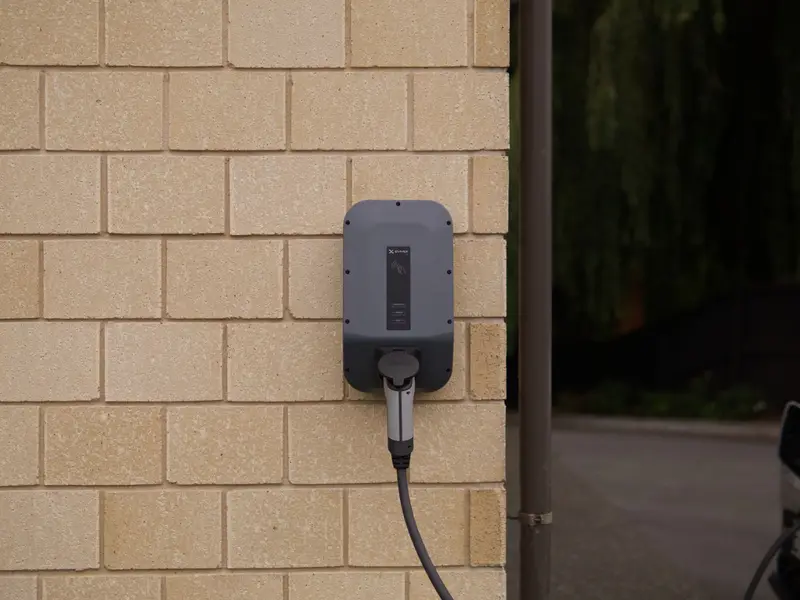
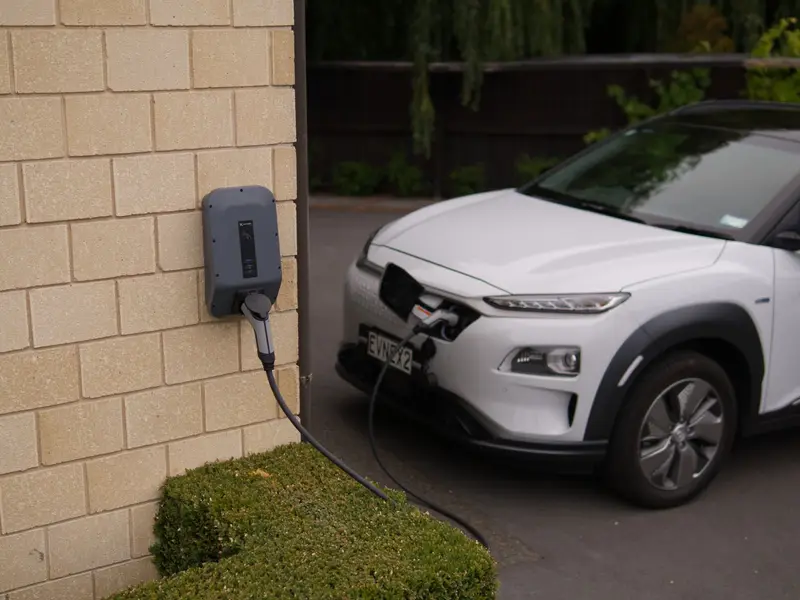
The box on your wall is properly called EVSE, short for electric vehicle supply equipment. Everyone (us included) calls it a charger, but what it actually does is deliver AC power to the car's onboard charger in a safe, controlled way.
That is why the car, not the wall unit, sets the speed limit for AC charging. Many popular EVs accept up to 7kW or 11kW AC. A Tesla Model 3 or Model Y sold in Australia accepts up to 11kW on three-phase, while a BYD Atto 3 accepts up to 7kW. Plug either into a bigger wall unit and it will still only draw what its onboard charger allows.
What the box on the wall actually does
A proper EV charger does a lot more than a power point. Every time you plug in, it runs through a short conversation with the car before any real power flows:
- It confirms the plug is in. A proximity signal in the connector tells the car and the charger that the cable is properly seated, and on socketed units it also signals what current the cable is rated for.
- It tells the car how much it may draw. A low-voltage control pilot signal advertises the available current. This is how a smart charger slows down when your house is busy, or speeds up when there is spare solar.
- It switches power on only when it is safe. Internal contactors stay open until the car says it is ready and no fault is detected. Unplug, or a fault appears, and the power cuts out.
- It watches for faults. EV charging needs protection suited to DC fault currents: either a Type B RCD, or a Type A RCD paired with 6mA DC fault detection built into the charger, as the manufacturer specifies.
Smart models add a layer on top of that: app control, scheduling, energy reporting, load management and solar matching. Those features change when and how fast the car charges, not its maximum speed. Our comparison of smart versus basic EV chargers covers whether they are worth paying for, and our smart EV charger installation page shows how we set them up.
AC charging versus DC fast charging
With AC charging the conversion happens inside the car, so power is limited to what the onboard charger can handle. That covers every portable cable and wallbox, plus the AC posts you see in shopping centre and council car parks.
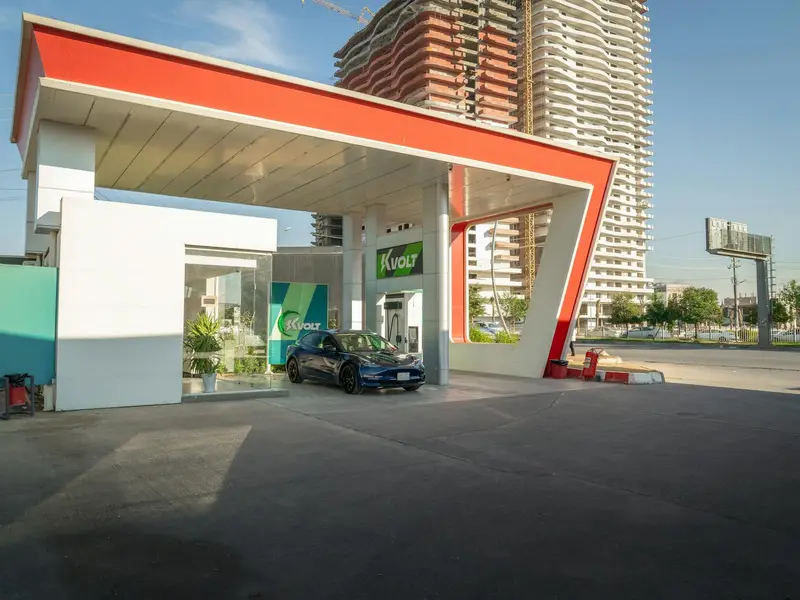
DC fast chargers move the converter out of the car and into the station. Because the station feeds DC straight into the battery, it bypasses the onboard charger and can deliver far more power: from 50kW up to 350kW at the biggest highway sites. That needs a large three-phase supply and serious infrastructure, which is why DC units belong at public hubs, fleet depots and commercial sites rather than homes.
| Feature | AC charging | DC fast charging |
|---|---|---|
| Where AC becomes DC | Inside the car (onboard charger) | Inside the charging station |
| Typical power | 2.3kW to 22kW | 50kW to 350kW |
| Speed limited by | The car's onboard charger and your supply | The car's maximum DC rate and battery level |
| Typical locations | Homes, workplaces, destination car parks | Highways, public hubs, fleet depots |
| Connector in Australia | Type 2 | CCS2 (CHAdeMO on a few models) |
If you want the full picture of power levels, charging modes and plug styles, read how many types of EV chargers there are, or see our EV charger types explained page for detailed specs on each.
The three places you will charge
A portable charging cable
Many EVs come with a portable cable, or offer one as an accessory, that plugs into a standard 10A power point. People call it a granny charger. It has a control box built into the cable that runs the same safety handshake as a wallbox. At about 2.3kW it adds roughly 10 to 15km of range per hour. Only use it in an existing, good-condition power point, and never through an extension lead or power board.
A wall-mounted charger
A wallbox is hard-wired on its own dedicated circuit. On the single-phase supply most Sydney homes have, a 7kW unit adds about 30 to 45km of range per hour, which is enough to refill most EVs overnight. With three-phase power and a compatible car, an 11kW unit adds about 50 to 60km per hour.
Public chargers
Public networks offer AC destination chargers at shopping centres, hotels and council car parks, plus DC fast chargers along highways and in town centres. They vary in plugs, speeds and how you pay, which we unpack in are all electric car charging points the same.
Do you need a charger at home?
Not strictly. If you drive short distances and the car sits at home for 10 hours or more most nights, a portable cable may keep up. Ten hours at about 2.3kW is roughly 100 to 150km of range, which covers a lot of local driving.
As a rough guide, a wallbox starts to make sense when:
- you regularly drive more than about 50km a day, or have long days back to back
- two drivers share the car, or there are two EVs in the household
- you want to charge in a cheap overnight or solar window rather than whenever there is time
- you would rather not run a heavy load through a general-purpose power point night after night
- you have rooftop solar and want to soak up the surplus
If you have no off-street parking, a home charger usually is not an option: running a cable across the footpath is generally not permitted and is a trip hazard. Workplace and public charging fill that gap. For houses, apartments and rentals, our guide on whether you can install an EV charger at home covers what your property needs.
What an EV charger costs to own and run
Upfront cost
A standard single-phase home charger supplied and installed typically costs $1,200 to $2,200 in Sydney. If you already have the unit, labour-only installs on short, simple runs are often under $1,000. Three-phase units, long or concealed cable runs and smart features cost more.
If your switchboard needs an upgrade, that is quoted separately. EV Install does not do switchboard upgrades itself: we coordinate them through trusted, fully licensed Level 2 ASP partner electricians and manage the process so you deal with one team. Our EV charger installation cost guide breaks down what moves the price.
Running cost
The charger itself uses very little power. What you pay for is the energy going into the car, so the maths is simple: kilowatt-hours used multiplied by your rate. A typical EV uses roughly 15 to 18kWh per 100km, so 10,000km a year works out to around 1,500 to 1,800kWh.
When you charge matters as much as how much. On a time-of-use or EV plan, overnight and some midday windows usually cost far less than the evening peak. Charging from surplus rooftop solar, instead of exporting it, is cheaper again. Tariffs and incentives change, so check your bill, your retailer and Energy NSW for current options.
Upkeep
Wallboxes need very little maintenance. Keep the cable coiled and off the ground where it could be driven over, accept firmware updates on smart units, and get an electrician to look at it if it trips repeatedly or the plug shows signs of heat. Expect a manufacturer hardware warranty (typically 3 years, varying by brand) on top of your installer's workmanship warranty.
Getting a home charger installed in Sydney
In NSW a wallbox must be installed by a licensed electrician, who issues a Certificate of Compliance for Electrical Work (CCEW) once the job is tested. When you are ready to choose a unit, which EV charger you need walks through the decision, and how to get an EV charger installed at home explains each step of the process.
EV Install has specialised in EV charger installation across Greater Sydney since 2017, and we are brand-independent. Book a free on-site quote through our home EV charger installation page and we will check your switchboard, cable run and car, then give you a fixed written price.
Related services
Written by Nathan Dawson, Founder & Lead EV Installer
A licensed electrician installing EV chargers across Sydney since 2017. Every install we quote is wired to AS/NZS 3000 and certified. More about Nathan.