Short answer
There are three main types of EV chargers, grouped by power: portable cables that plug into a power point (Level 1), wall-mounted AC chargers (Level 2) and DC fast chargers (Level 3). Chargers are also described by connector, phase, cable style and smart features, but those are variations within the three types.
Key takeaways
- Three main types by power: portable cable (Level 1), AC wall charger (Level 2) and DC fast charger (Level 3).
- The international standard IEC 61851 calls them Mode 2, Mode 3 and Mode 4.
- Australia uses Type 2 plugs for AC and CCS2 for DC; CHAdeMO and Type 1 appear on some older cars.
- Homes use portable or AC wall chargers. DC fast chargers belong on highways, fleet depots and commercial sites.
Search for EV charger types and you will find lists of three, five, eight or more. They are not contradicting each other: they are counting different things. Some count power levels, some count plug shapes, some count features like smart or tethered. The useful way to think about it is three main types of charger, defined by how much power they deliver and where the AC to DC conversion happens, with everything else being a variation within those three. Here is the count, the variations, and which ones actually matter for a Sydney home, business or road trip.
The three main types of EV charger
Every charger you will plug into falls into one of these groups. The labels Level 1, 2 and 3 are informal American terms that are used loosely in Australia, while Mode 2, 3 and 4 come from the international charging standard IEC 61851.
| Type | Also called | Typical power | Range added per hour | Where you find it |
|---|---|---|---|---|
| Portable charging cable | Level 1, Mode 2 | About 2.3kW from a 10A power point (about 3.6kW from a 15A outlet) | About 10 to 15km at 10A | Home power points, holiday houses, visits |
| AC wall charger | Level 2, Mode 3 | 7kW to 7.4kW single-phase, 11kW or 22kW three-phase | About 30 to 45km at 7kW, about 50 to 60km at 11kW | Homes, workplaces, apartment and destination car parks |
| DC fast charger | Level 3, Mode 4 | 50kW up to 350kW | Far faster, limited by the car's DC rate and battery level | Highway sites, public hubs, fleet depots, dealerships |
The first two are both AC chargers: they supply AC power and the car's onboard charger converts it to DC for the battery, which caps their speed. The third puts the converter inside the station and feeds DC straight to the battery. If that distinction is new to you, start with what an EV charger actually is.
Level 1 portable charging cables
A portable cable has a plug at one end, a car connector at the other, and a control box in the middle that handles the safety checks. Many EVs come with one or offer it as an accessory.
In a standard 10A power point it runs at about 2.3kW. A 15A version delivers about 3.6kW, but it needs a 15A outlet on a dedicated circuit installed by an electrician, and it must never be forced into a 10A socket with an adapter. Portable cables are slow but useful as a backup, a travel cable or a starting point while you decide on a wallbox. Always plug them straight into a good-condition outlet, never an extension lead or power board.
Level 2 AC wall chargers
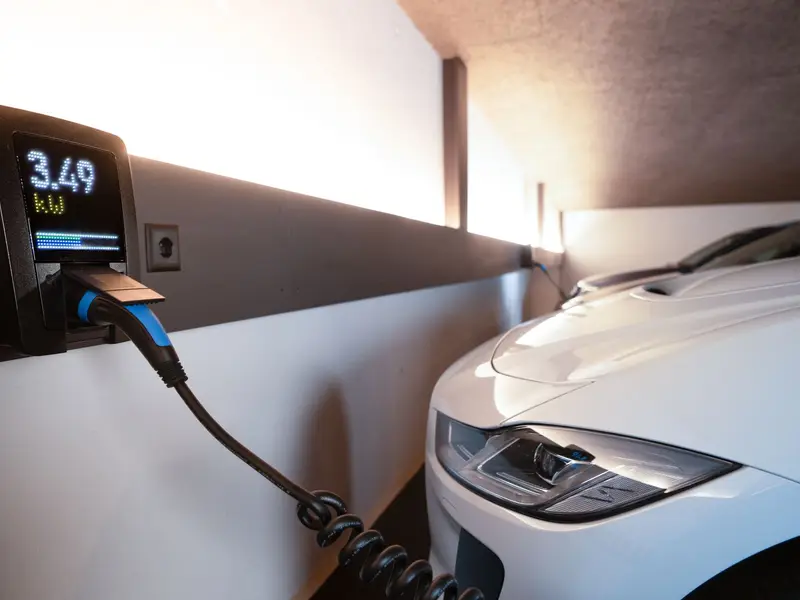
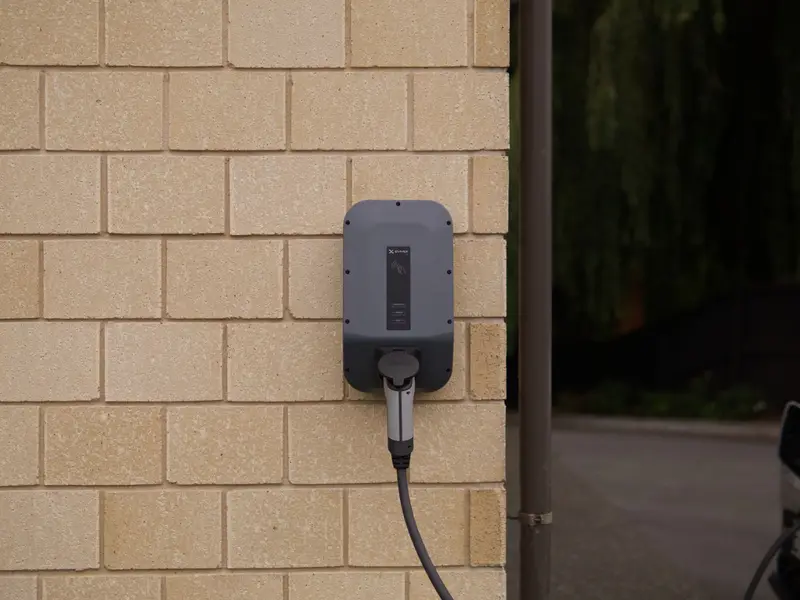
This is what most people mean by a home EV charger: a wall or post-mounted unit hard-wired on its own circuit. It comes in three common power ratings:
- 7kW to 7.4kW single-phase (32A). Suits the single-phase supply most Sydney homes have and refills most EVs overnight.
- 11kW three-phase (16A per phase). Faster, but only if you have three-phase power and your car's onboard charger accepts three-phase AC.
- 22kW three-phase (32A per phase). Only faster than 11kW on the few models whose onboard charger accepts 22kW AC, so it is mainly a commercial and destination option.
Level 3 DC fast chargers
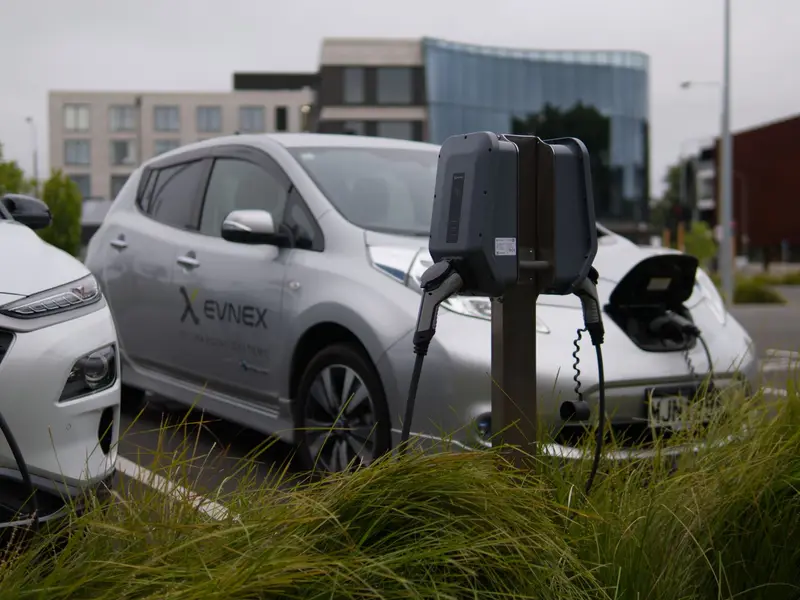
DC chargers are typically large cabinets with a heavy tethered cable, ranging from 50kW units in town centres to 350kW units at major highway sites. They need a large three-phase supply, significant electrical infrastructure and often network approval, and the hardware costs many times more than a wallbox. That is why they are commercial equipment, not home equipment.
Even at a DC charger, the car has the final say. Each model has a maximum DC rate, and charging slows as the battery fills, most sharply above about 80 percent. Plug a car with a modest DC limit into a 350kW unit and it simply charges at its own maximum.
Other ways chargers are classified
Once you know the three types, the other labels you see are ways of describing a charger within a type.
Charging modes
IEC 61851 describes Mode 2 (portable cable with an in-cable control box), Mode 3 (dedicated AC charger with a fixed connection) and Mode 4 (DC). Mode 1, a basic cable with no control or communication, is not used for modern cars. You will mostly see modes mentioned on cables and spec sheets.
Connector types used in Australia
- Type 2 (Mennekes): the standard AC connector, used by almost every new EV and plug-in hybrid here, including Teslas.
- CCS2 (Combo 2): the standard DC fast-charging connector, which adds two large DC pins below a Type 2 inlet.
- CHAdeMO: a legacy DC standard on cars such as earlier Nissan Leaf models and the Mitsubishi Outlander PHEV.
- Type 1 (J1772): appears on some older or imported vehicles.
Which plug works where is a big enough topic for its own page: see whether all electric car charging points are the same.
Tethered or untethered
A tethered charger has a fixed cable; an untethered one has a Type 2 socket and you bring your own cable. Speed is identical for the same rating. Tethered is more convenient at home; untethered suits shared driveways, mixed vehicles and many public posts.
Smart or basic
Smart chargers add app control, scheduling, load management and often solar matching. They are a feature set rather than a separate type, and the same power limits apply. Our smart versus basic EV charger comparison covers who benefits.
Single-phase or three-phase
Most Sydney homes have single-phase power, which tops out at about 7.4kW. Three-phase allows 11kW or 22kW, but only matters if your car can use it. Upgrading a home to three-phase involves your local network operator and Level 2 ASP work (which we coordinate through licensed partner electricians) and can cost several thousand dollars, so read whether you need three-phase power for an EV charger before assuming you do.
Bidirectional chargers
Vehicle-to-home and vehicle-to-grid chargers can send power from the car back to the house or grid. They are emerging in Australia, but compatible cars and chargers are still limited, so check both before buying.
Which type suits your situation
At home
For most households the answer is a 7kW single-phase wallbox, with the portable cable kept as a backup. An 11kW unit makes sense if you already have three-phase power and a car that accepts it. DC fast charging at home is not practical: the supply and cost are out of proportion to what an overnight charge needs. Our EV charger types explained page has full specs and example models for each home option.
Apartments and strata buildings
Shared car parks usually suit AC wallboxes on a building-wide system with load management, so many cars can charge without the building's supply being exceeded.
At work and in business
Staff and visitors who park for hours suit AC chargers, often 7kW to 22kW with load management. DC fast chargers earn their place where turnaround matters: fleet depots, dealerships, service stations and retail sites with short visits. See DC fast charger installation for what that involves, or the benefits of workplace EV charging if you are weighing up chargers for staff.
On road trips
Long trips rely on public DC fast chargers along highways, with AC destination chargers at hotels and attractions for overnight top-ups. Plan stops with your network apps and allow for slower charging as the battery fills.
Getting the right charger installed
Knowing the types is step one. Choosing the right unit means matching it to your car's onboard charger, your supply, your parking and your tariff, which we walk through in which EV charger do I need.
EV Install installs dedicated 15A outlets, AC wallboxes and DC fast chargers across Greater Sydney. For a home charger, book a free on-site quote through our home EV charger installation page; for a business site, contact us and we will give you a fixed written quote after assessing the site.
Related services
Written by Nathan Dawson, Founder & Lead EV Installer
A licensed electrician installing EV chargers across Sydney since 2017. Every install we quote is wired to AS/NZS 3000 and certified. More about Nathan.