Short answer
There are ten core requirements: 12 months of interval data and a maximum demand assessment, adequate supply capacity, dynamic load management that prioritises solar surplus, correct inverter and export settings, suitable chargers, compliant cabling and protection, building and fire approvals, a tariff strategy, an optional battery decision, and proper commissioning and monitoring.
Key takeaways
- Start with 12 months of interval data: it shows real maximum demand and solar export, which sets how many chargers the site can support.
- Dynamic load management that prioritises solar surplus often lets a site add many chargers without upgrading its supply.
- Existing inverters need review: export limits, CT placement and settings must still work, and stay compliant, once chargers are added.
- Most of Parramatta is in Endeavour Energy's network area; supply or switchboard upgrades are coordinated through EV Install's Level 2 ASP partner electricians.
- Basement car parks need early input from the building's fire safety adviser, plus strata or landlord consent where relevant.
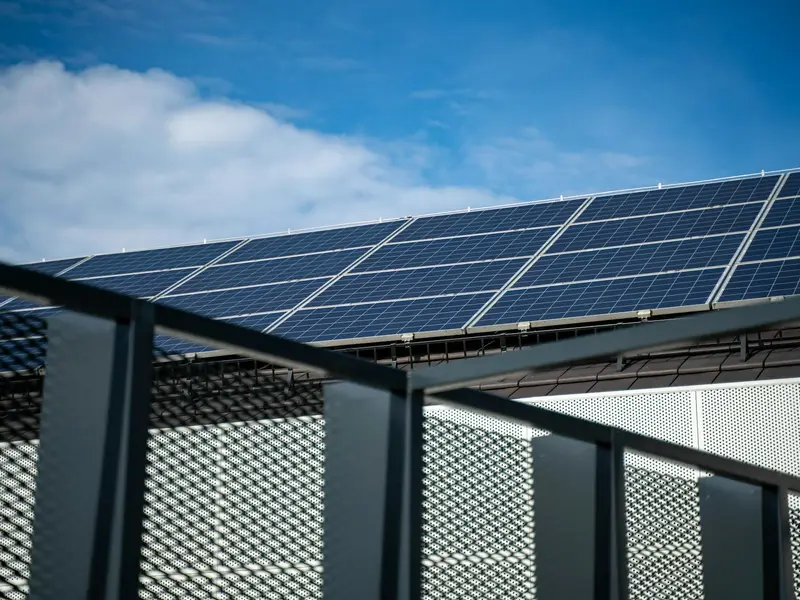
If your business already has a large solar system on the roof, it is natural to ask whether it can power a car park full of EV chargers. Often it can supply a meaningful share of the energy, but connecting dozens of chargers to a site that already generates and exports solar is an engineering project, not a bigger home install. The chargers, inverters, switchboard and network connection have to behave as one system. Below is the framework we use: ten technical requirements, who is responsible for each, and a hypothetical worked example.
Parramatta adds its own context. As Sydney's second CBD, it mixes office towers, mixed-use and strata buildings with basement car parks, plus business parks and light industrial sites across the wider area. Basement sites raise fire safety and consent questions, while low-rise business parks often have the roof space for large arrays. For local details, see our Parramatta service area page.
Assess the site and supply first
1. Twelve months of interval data and a maximum demand assessment
Ask your retailer or metering provider for at least 12 months of interval data. It shows your true maximum demand, when it occurs (often hot summer afternoons for air-conditioned offices), and how much solar you export or lose to an export limit. Because the meter only sees net flows, pair it with inverter monitoring, which shows gross generation.
AS/NZS 3000 recognises measurement and load limitation as ways of establishing maximum demand, which is why measured data plus load management usually gives a more accurate, and less expensive, answer than adding up nameplate ratings.
2. Supply capacity and the network connection
Spare capacity is your supply rating less measured maximum demand, less a sensible margin. Most of Parramatta sits in Endeavour Energy's network area (confirm the distributor named on your bill), and if the planned load exceeds what the connection can deliver, the network operator determines what is needed. On larger sites that can include network augmentation or a new substation, which is designed and built by Level 3 and Level 1 ASPs under the network operator's rules.
EV Install does not carry out switchboard upgrades, service mains, metering or other network-side work. Where a project needs these, or a connection application, we coordinate it through trusted, fully licensed Level 2 ASP partner electricians and manage the process, so you deal with one team. For background, see whether you need three-phase power for an EV charger.
Make solar and chargers work together
3. Dynamic load management and an energy management system
A large installation needs a controller that measures the whole site in real time, through current transformers (CTs) or a meter at the main switchboard, and allocates current to each charger over OCPP. It works to two limits: a hard ceiling that protects the supply, and a soft target, such as holding grid import below your historical peak, or near zero when solar is strong. Good designs also cover:
- Phase balancing. Spread single-phase chargers evenly across the three phases.
- Minimum current. Chargers cannot run below about 6A (about 1.4kW single-phase, 4.1kW three-phase), so with a small surplus the controller should rotate cars rather than trickle-feed all of them. Our guide to EV charging options for homes with solar explains this limit.
- Priorities. Fleet vehicles due out first or visitor bays can be ranked by rule.
- Failsafe. If communications drop, chargers should fall back to a safe low current.
4. Integrating with the existing solar inverters
The panels rarely change, but the system needs review:
- Export limits. Many commercial systems have an export limit in their network connection agreement, enforced by an export controller. Changes must not compromise it.
- CT and meter placement. The export controller and EV load manager must measure the same grid connection point, or they can fight each other and oscillate.
- Inverter settings and compliance. Inverters must stay compliant with the AS/NZS 4777 series and network requirements, and any central protection must not be disturbed.
- Data integration. Many inverters can share live generation data, commonly over Modbus, with an energy management system.
Inverter settings should be changed only by the solar installer or maintenance contractor, with EV Install coordinating joint commissioning.
Choose and install the right hardware
5. Charger selection
Match chargers to dwell time. Cars parked all day suit AC charging: 7kW single-phase or 11kW three-phase units with Type 2 connectors. DC chargers with CCS2 connectors suit fleet turnaround or short-stay visitors, but are a far larger load, as our DC fast charger installation page explains. Depots should be designed around shift patterns, covered in fleet charging solutions.
Every charger should support OCPP. Protection suited to DC fault currents is essential: a Type B RCD, or a Type A RCD where the charger has built-in 6mA DC fault detection, as the manufacturer specifies.
6. Distribution boards, cabling, protection and certification
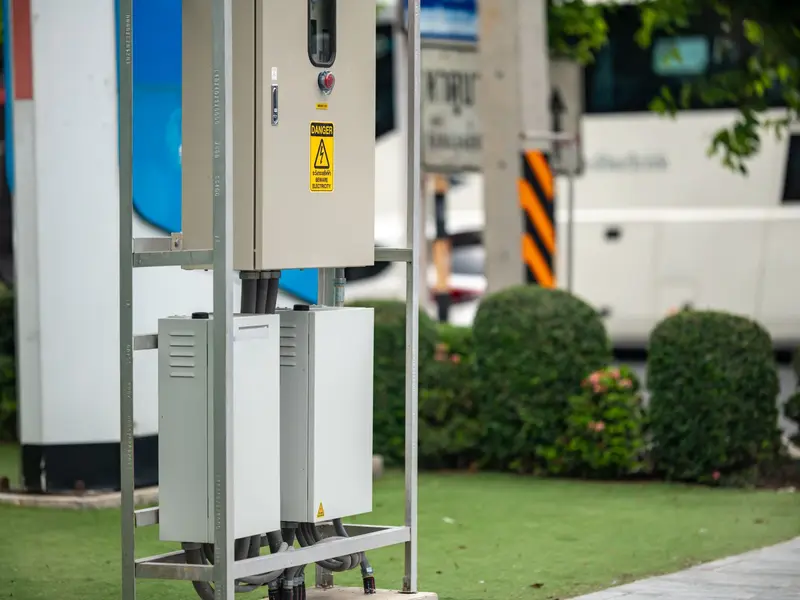
Large car parks typically use a dedicated EV distribution board fed by a submain sized for the final number of bays, not just stage one. Cabling is selected to AS/NZS 3008 for current capacity and voltage drop over long runs, with derating where cables are grouped. Each charger gets its own RCBO-protected circuit.
Cables need mechanical protection, and chargers need bollards or wheel stops. The installation is tested to AS/NZS 3017, certified to AS/NZS 3000, and a Certificate of Compliance for Electrical Work (CCEW) is issued. Our car park EV charging stations page covers bay layout and signage.
Planning and fire safety approvals
7. Building, fire and planning considerations
NCC 2022 introduced EV-ready requirements for car parks in new buildings, so for new building work your certifier will confirm what applies. For existing buildings:
- Basement car parks. Engage the building's fire safety adviser early on charger locations, clearance from exits and fire services, signage and isolation.
- Council approval. Many installs are low impact, but solar carports, heritage items or layout changes can trigger approval, so check with City of Parramatta Council.
- Landlord and strata consent. Tenants need landlord consent. Strata buildings need owners corporation approval for common property, and NSW strata law has a sustainability infrastructure resolution (more than 50 percent) that can cover EV charging.
Running costs and long-term performance
8. Metering, demand charges and tariff strategy
Many commercial tariffs include demand charges based on your highest demand, so one uncontrolled afternoon can set an expensive peak. Set the load manager's import target at or below your existing peak from the interval data, so charging fills gaps in your load profile instead of creating new peaks. Sub-meter the chargers for reporting and any cost recovery, and ask your retailer whether your tariff still suits the new profile. Main meter changes go through your retailer, with on-site work by a Level 2 ASP partner.
9. Optional battery storage
A battery is not a prerequisite, because workplace cars are usually parked while the sun shines. It can make sense where surplus does not line up with charging, such as overnight fleet charging, or to trim demand peaks. It adds cost, usually needs network approval and has its own fire safety requirements, so model it against your interval data first.
10. Commissioning, monitoring and reporting
Commissioning should prove the whole system: load management under high building load, failsafe current when communications drop, export control with charging active, and user access. After handover, the management platform should flag faults and report energy per user, per bay and from solar for cost recovery and emissions reporting.
Who is responsible for each requirement
Projects run more smoothly when ownership is clear. This is how responsibilities typically divide.
| Requirement | Led by | Also involved |
|---|---|---|
| 1. Interval data and maximum demand | EV Install (analysis) | Building owner or tenant (requests the data) |
| 2. Supply and network connection | Level 2 ASP partner, coordinated by EV Install | Network operator (Endeavour Energy for most of Parramatta) |
| 3. Load and energy management | EV Install | Solar installer, building owner |
| 4. Solar inverter integration | Solar installer | EV Install, network operator (export limits) |
| 5. Charger selection | EV Install | Building owner or fleet manager |
| 6. Boards, cabling, protection and certification | EV Install (issues the CCEW) | Level 2 ASP partner for main switchboard or service work |
| 7. Building, fire and planning | Building owner or strata | Fire safety adviser, council, EV Install |
| 8. Metering, demand charges and tariffs | Building owner (retailer and tariff) | EV Install, Level 2 ASP partner (meter work) |
| 9. Battery storage (optional) | Solar or battery installer | EV Install, network operator |
| 10. Commissioning and monitoring | EV Install | Solar installer, facilities team |
Worked example for a Parramatta office
This hypothetical scenario shows the reasoning only. It is not a quote or a real project. Picture a Parramatta office with an existing 100kW rooftop system, a basement car park and 20 staff who drive EVs.
- Energy need. Assume a 40km average round trip. At 15 to 18kWh per 100km, that is roughly 6 to 7kWh per car, or about 120 to 145kWh a day for all 20.
- Power need. Spread over an eight-hour day, that averages under 20kW. Twenty 7kW chargers at full speed could draw 140kW, but load management bridges the gap.
- Solar match. If the data showed, say, 30 to 40kW of midday surplus on clear days, a solar-first controller could cover much of the need from the roof, with the grid topping up on cloudy days.
- Charger choice. Single-phase 7kW units balanced across the phases would use a fluctuating surplus better than three-phase units, because each can run down to about 1.4kW. No DC charging is needed.
- Supply and approvals. If measured peak demand left headroom, the likely design is a new EV distribution board on a submain sized for future bays, with no supply upgrade, plus a fire safety review of the basement layout.
With good data, a site like this can need far less infrastructure than the headline numbers suggest.
Planning your Parramatta project
We start with your interval data, solar details and a walk-through of the car park before designing anything. EV Install has specialised in EV charging since 2017 and handles design, installation, commissioning and certification, coordinating Level 2 ASP partners, your solar installer and the network operator where needed. Read more about workplace EV charging in Parramatta, solar EV charger integration in Parramatta and the benefits of installing EV chargers at workplaces, or request a free on-site assessment for a fixed written quote.
Related commercial services
Written by Nathan Dawson, Founder & Lead EV Installer
A licensed electrician installing EV chargers across Sydney since 2017. Every install we quote is wired to AS/NZS 3000 and certified. More about Nathan.