Short answer
A solar-aware smart charger with a CT clamp works best for most homes with solar, because it matches the charge rate to your surplus automatically. Scheduled midday charging with a basic charger is the budget option. Home batteries, Tesla's Powerwall-based features and bidirectional charging suit specific households and depend on your car and system.
Key takeaways
- A solar-aware charger with a CT clamp matches charging to your surplus and suits most solar homes.
- Solar charging only works when the car is home in daylight, so most owners also charge off-peak.
- Chargers need at least 6A: about 1.4kW of surplus on single-phase but about 4.1kW on three-phase.
- A typical 6.6kW system can produce 25 to 30kWh on a sunny day, often enough surplus for a solid day of driving.
- Home batteries are too small to fill an EV, so set them not to discharge into the car.
If you already have rooftop solar, adding an EV changes how you think about it. Your panels were probably sized to cut the power bill, and much of what they make in the middle of the day goes back to the grid. Charging a car from that surplus is one of the best uses for it, but how well it works depends on the charger, your supply, your inverter and, above all, whether the car is parked at home while the sun is up.
How solar EV charging actually works
Your car never charges straight from the panels. Solar power flows through your inverter into the switchboard, the house uses what it needs and the rest is exported. A solar charging setup redirects some or all of that export into the car.
The smarter setups do it with a CT clamp, a small current sensor fitted around the main cable at your switchboard. It measures in real time whether you are importing or exporting, and the charger raises or lowers its charging current to soak up the surplus. When a cloud passes or the kettle goes on, the rate drops. When the sun comes back, it climbs again.
The biggest constraint has nothing to do with hardware. Solar charging only works when the car is home during daylight. If your EV is at work from 8am to 6pm on weekdays, solar charging is mostly a weekend bonus and overnight off-peak charging will do most of the work.
The 6A minimum and why phases matter
EV chargers cannot charge below about 6A. On single-phase supply that is about 1.4kW, so a single-phase solar charger can start once you are exporting a modest amount. On three-phase it is about 4.1kW (6A on each of three phases), which needs a lot more surplus before charging can start on solar alone.
That flips the usual thinking. Three-phase is better for fast charging but worse for soaking up small amounts of surplus. There are two common ways around it:
- Automatic phase switching. The Fronius Wattpilot can switch between one and three phases automatically, charging on a single phase when surplus is low and moving to three phases when there is plenty.
- Blended modes. Most solar-aware chargers offer a solar-only mode and a blended mode that uses all available surplus but tops up from the grid to keep charging at the minimum rate. The myenergi zappi calls these Eco+ and Eco.
Whether three-phase is worth having in the first place is a separate question, covered in do you need 3 phase power for an EV charger.
Five ways to charge your EV from solar
Solar-aware smart charger with a CT clamp
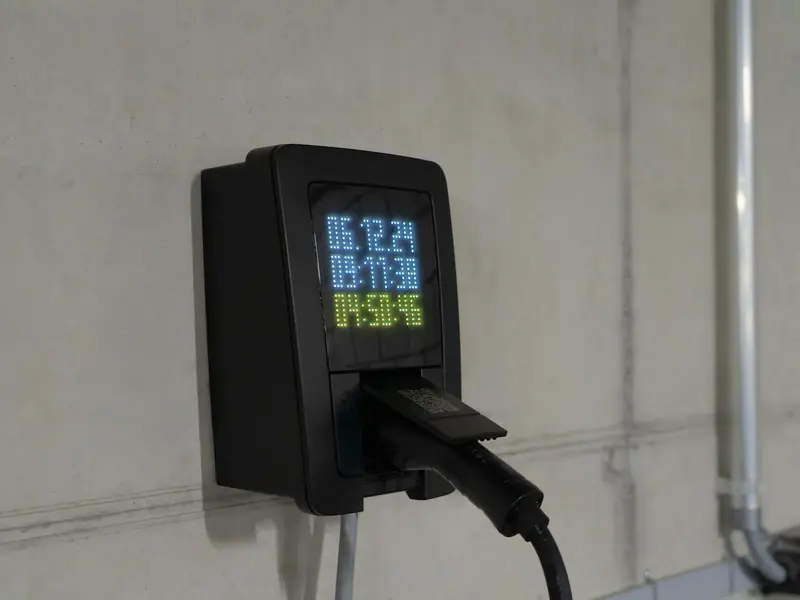
This is where most solar households should start. The charger follows your surplus automatically, and you choose solar-only, blended or fast charging in the app. Popular units include the myenergi zappi, which works alongside most inverter brands, the Fronius Wattpilot, which takes its solar data from a Fronius Smart Meter (usually paired with a Fronius inverter), so it suits homes with a Fronius system, and the Wallbox Pulsar Plus, which can do solar charging with an add-on power meter. Our solar EV charger integration service covers fitting and commissioning the CT clamp so solar mode works from day one.
Scheduled midday charging with a basic charger
No CT clamp and no solar mode, just a schedule that charges during the sunniest hours. It costs less upfront and works reasonably well with a large system on clear days. The downside is that the charger draws a fixed rate regardless of your surplus, so on cloudy days or when the house is busy you import the difference from the grid. Lowering the charging current in the car's settings, where your car allows it, helps match a smaller system. Our guide to setting up scheduled off-peak EV charging covers the settings.
Tesla ecosystem
Tesla's own solar charging features generally rely on a Tesla Powerwall, which measures your solar and home load and tells the car how much surplus is available. A Tesla Wall Connector on its own does not read your solar. If you drive a Tesla and have, or plan to add, a Powerwall, the Tesla app can be a tidy all-in-one option. Without one, a solar-aware charger or a scheduled approach is usually simpler.
Home battery plus EV
A home battery stores daytime surplus for your evenings. It is usually too small to fill an EV, and draining it into the car just shifts your evening use back onto the grid. Most owners set the battery not to discharge into the car, then decide which gets solar first. One sensible approach is battery first in the morning and car once the battery is full, though the right order depends on when you and the car are home.
Bidirectional V2H and V2G charging
Vehicle-to-home (V2H) lets the car's battery power your house, and vehicle-to-grid (V2G) lets it export to the grid. Both are emerging in Australia, with a limited range of compatible cars and chargers and connection requirements that are still settling. If this appeals, check that your specific car and charger are compatible and can be approved by your network operator before buying anything, and treat it as a bonus rather than the main reason to choose a car today.
How much solar do you need to charge an EV?
Here is a worked example. A typical 6.6kW rooftop system can produce around 25 to 30kWh on a sunny day. Suppose your home uses 8 to 10kWh of that while the sun is up. That leaves roughly 15 to 20kWh of surplus.
Most EVs use about 15 to 18kWh per 100km, so that surplus could cover somewhere around 80 to 130km of driving on a good day, more than many people drive daily. In practice you capture less, because cloudy days, short winter days, the 6A minimum and days the car is away all reduce it. Winter output in particular can sit well below the sunny-day figure.
As a rough guide:
- Around 30 to 50km a day (about 5 to 9kWh): an average-size system with a solar-aware charger can cover much of it on days the car is home.
- 100km or more a day: expect solar to supplement overnight charging rather than replace it, unless you have a large system and the car is home most days.
- Adding panels? Size for the car's energy plus your daytime load, and check your export limit before you buy.
Incentives for solar, batteries and chargers change regularly, so check Energy NSW rebates, grants and schemes and our NSW EV charger rebates guide for what currently applies.
Export limits and why charging captures more value
Many homes cannot export everything their panels produce. Network operators often set export limits, and when your system hits the limit, the inverter throttles back and the extra generation is simply lost. Feed-in tariffs for exported solar are also generally much lower than the price you pay for grid power.
That makes the car a valuable place to put surplus. Every kWh that goes into the car instead of being exported or curtailed is a kWh you do not buy back later. Charging while your system is at its export limit can also let the inverter produce some of the energy it was holding back.
If you are on a plan with a cheap or free midday window, daytime charging can be cheap even without surplus. Our guide on whether you need a smart meter for EV charging explains how those plans work and what they require.
Which option suits your household
| Option | How it uses solar | Best for | Watch out for |
|---|---|---|---|
| Solar-aware charger with CT clamp | Measures export and varies the charge rate to match surplus | Most solar homes where the car is home during the day | Needs correct CT clamp placement. Three-phase needs more surplus to start. |
| Basic charger on a midday schedule | Charges at a fixed rate during sunny hours | Large systems and tighter budgets | Imports from the grid whenever surplus is below the charge rate |
| Tesla ecosystem | Solar charging features generally work through a Powerwall | Tesla drivers who have or plan a Powerwall | The Wall Connector alone does not read your solar |
| Home battery plus EV | Battery covers the house while the car takes surplus or off-peak power | Homes with high evening use | Battery is too small to fill the car. Set it not to discharge into the EV. |
| Bidirectional V2H or V2G | The car battery can power the home or export | Early adopters with a compatible car | Limited compatible cars and chargers. Check compatibility and approvals first. |
Matching that to real households:
- Car home most weekdays: a solar-aware charger with a CT clamp, whatever the system size.
- Car away all day: overnight off-peak charging with solar top-ups on weekends. A smart charger still helps with scheduling.
- Tesla driver with a Powerwall: the Tesla app may be all you need.
- Three-phase home with a modest system: a charger that switches phases, such as the Wattpilot, or a blended mode.
- Budget first with a big system: a basic charger on a midday schedule, with the option to upgrade later.
- Two EVs: a solar-aware charger for the car that is home by day, and scheduled overnight charging for the other.
Getting a solar-aware charger installed
Our project gallery shows the kind of solar-integrated setups we install, including myenergi zappi and Fronius Wattpilot chargers. On solar jobs we check your inverter, any battery, your export settings and your supply phase, fit and test the CT clamp, then confirm the charger reads your import and export correctly in the app.
If you are still weighing up hardware, our smart EV charger installation service and the charger brands we install are good next stops. Or book a free on-site quote and we will recommend the simplest setup that gets the most from your panels.
Related services
Written by Nathan Dawson, Founder & Lead EV Installer
A licensed electrician installing EV chargers across Sydney since 2017. Every install we quote is wired to AS/NZS 3000 and certified. More about Nathan.